

_edited.jpg)
RESI Releases Strategic Policy Paper on Floating Solar Photovoltaics (FSPV) and Storage Integration
A Technical Framework for Scaled Deployment in India
New Delhi, July 2026 — The Renewable Energy Society of India (RESI) has unveiled its latest policy paper, “Floating Solar Photovoltaics (FSPV) and Storage Integration: A Strategic Technical Framework for Scaled Deployment in India.” The publication provides a comprehensive roadmap for harnessing India’s vast water‑body potential to accelerate solar capacity expansion while addressing land‑use constraints.

India’s clean‑energy transition is entering a decisive phase as the nation advances toward its 500 GW non‑fossil fuel capacity target by 2030 and net‑zero emissions by 2070. With land availability emerging as a critical bottleneck for ground‑mounted solar, Floating Solar Photovoltaics (FSPV) offer a land‑neutral, high‑yield alternative that simultaneously enhances water conservation and system efficiency.
According to the National Institute of Solar Energy (NISE) 2026 geospatial assessment, India’s realistic FSPV potential stands at 102.18 GWp, assuming a conservative 20 percent surface‑utilisation constraint.
The RESI paper builds on this foundation, analysing technical performance, cost trajectories, tariff structures, and the system value of co‑located energy storage.
“Floating solar represents the next frontier in India’s renewable expansion—combining innovation, sustainability, and spatial efficiency. Our framework aligns with national priorities and supports hybrid deployment models integrating battery storage.” Ajay Mishra, DG RESI
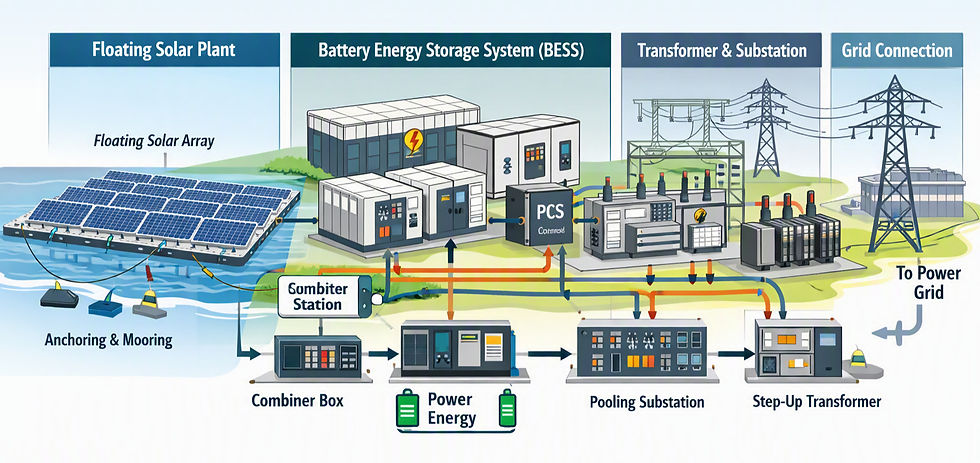
The paper synthesises data from six large floating solar parks aggregating 1,077 MW sanctioned under the Solar Parks programme of Govt of India, alongside international best practices from China, Singapore, and the Netherlands. It proposes a strategic deployment framework to guide policymakers, Central Public Sector Undertakings (CPSUs), state agencies, developers, and financial institutions in optimising water‑body utilisation for hybrid solar‑storage systems.
Key Highlights
National Potential Assessment — 102.18 GWp under NISE 2026 study
Hybrid Deployment Models — Integration with battery storage for grid stability
Policy Recommendations — Framework for prioritised water‑body utilisation
International Benchmarks — Lessons from China, Singapore, and the Netherlands
Publication Details
Title: Floating Solar Photovoltaics (FSPV) and Storage Integration: A Strategic Technical Framework for Scaled Deployment in India
Series: Renewable Energy Chronicles: The Power Saga Vol. 07 / 2026 ISBN: 978‑81‑993949‑6‑4
Publisher: Renewable Energy Society of India (RESI), New Delhi Contact: info@resiindia.org | resocietyofindia@gmail.com Website: https://www.resiindia.org
Abstract
As India advances toward its 500 GW non-fossil fuel capacity target by 2030 and net-zero goals by 2070, land acquisition constraints for ground-mounted solar have become increasingly binding. Floating Solar Photovoltaics (FSPV) offer a strategically important, land-neutral alternative that simultaneously delivers higher specific energy yields through evaporative cooling, reduced soiling losses, and measurable water-conservation benefits. The National Institute of Solar Energy (NISE) 2026 geospatial assessment quantifies a realistic national potential of 102.18 GWp under a conservative 20% surface-utilisation constraint [1].
This paper presents a comprehensive technical and policy analysis of FSPV in India. It synthesises the latest official potential assessment, detailed project-level deployment data (including the six large floating solar parks aggregating 1,077 MW sanctioned under the Solar Parks scheme), performance characteristics, cost and tariff dynamics, and the system value of co-located energy storage. Drawing on international experience from China, Singapore, the Netherlands and other leading markets, the paper proposes a strategic framework for optimised utilisation of India’s water-body resources through prioritised hybrid deployment with storage. The analysis is intended to serve as a reference document for policymakers, Central Public Sector Undertakings, state agencies, developers and financial institutions.
Keywords: Floating Solar Photovoltaics (FSPV), Energy Storage Integration, Solar Potential Assessment, Hybrid Hydro-Solar Systems, Renewable Energy Policy, Water-Body Resource Utilisation, India Clean Energy Transition
Citation
Floating Solar Photovoltaics (FSPV) and Storage Integration: A Strategic Technical Framework for Scaled Deployment in India. Renewable Energy Chronicles: The Power Saga (ISBN: 978-81-993949-6-4). Renewable Energy Society of India (RESI), New Delhi | Infor@resiindia.org /resocietyofindia@gmail.com | https://www.resiindia.org/
Report:


Comments